
Helium 'People's Network Misleading Promises❓,Google Cloud’s Web3 portal sparks debate,🎸Web3 Rock and Heavy Metal Band Launches NFTs
Unleashing Web 3 Awesomeness Powered By Spheron Network

In today’s edition:
Deep Dive into Helium
Google Cloud’s Web3 portal launch sparks debate in crypto industry
Web3 Rock and Heavy Metal Band Launches NFTs
Your Weekly dose of Web3
Total Read Time: 10 Min 23 Seconds
🔎 Deep Dive
Helium Misleading Promises? A Closer Look at the 'People's Network
Welcome to our Deep Dive section, where we examine the cutting-edge technology behind Web3 infrastructure, DePIN, and blockchain. Today, Helium is a trailblazing decentralized wireless infrastructure project specifically designed for the Internet of Things (IoT) sector.
This analysis delves into the Helium project's intricacies, exploring its innovative aspects and contentious points. It aims to separate fact from fiction and help readers form informed opinions regarding the project's merits and potential.
Here is How Everything Started. (History & Founders)
Helium Web3 was founded in 2013 by Amir Haleem, Shawn Fanning, and Sean Carey. The idea behind Helium was to create a decentralized wireless infrastructure that could support the rapidly growing Internet of Things (IoT) industry. The founders aimed to lower the barriers to entry for IoT connectivity by creating a people-powered network driven by economic incentives. This vision was inspired by the decentralized model of Napster, a file-sharing application founded by Shawn Fanning, and the desire to apply a similar model to the IoT sector. The Helium Network was launched in 2019 to deliver a decentralized, open-source, accessible, and secure wireless network for the world, becoming the largest LoRaWAN network globally with hundreds of thousands of Hotspots deployed.
At its core, Helium is a novel concept. It aims to build a mesh network that supplies better network coverage for IoT devices. As we digitize more devices and industrial processes, usage and consumption needs will keep increasing. The problem is that it requires resources and a lot of money.
So, in 2017, Helium’s management let people set up and own the network, resulting in a decentralized network with widespread coverage and low overhead. It managed this by introducing physical hotspots that people can purchase and install in their homes. Why would people do that? Because these hotspots also double as physical blockchain nodes. The company created its crypto token, the Helium Network Token (HNT), and rewards hotspot owners for purchasing the hardware and providing network coverage.
Many industrial IoT network solutions like ZigBee or Twilio IoT already exist that have carved out a vested user base. Helium is even built on the already established LoRaWAN frequency range (which it renamed LongFi for its system). The biggest differences between Helium and these networks is its focus on long-distance connectivity (most are used for local connectivity, although some allow larger “mesh” networks), and its integration with the blockchain.
Since its launch in July 2019, Helium has had a number of successes and managed to create a name for itself. Adoption has grown by leaps and bounds—there are currently around 44,000 hotspots in Canada alone. Any company naturally experiences hurdles, too, especially at the start, and Helium isn’t any different. However, recent setbacks seem to be increasing in rate and severity.
Here's how Helium works🤔
Helium aims to create a reliable, decentralized, and global network for IoT devices that relies on the community of HNT holders. The network consists of nodes, i.e., Hotspots, run by node operators who are HNT holders. Hosting Hotspots and managing nodes incentivizes users to participate in the network’s functionality.
WiFi already supports IoT devices. However, supporting as many different devices as possible raises privacy concerns. Helium solves this issue using a decentralized architecture and consensus mechanism that gives the network 200 times greater coverage than WiFi connections with the IoT.
The consensus mechanism that the network runs on is known as Proof of Coverage and is also responsible for distributing rewards to HNT holders and node operators. Users need to purchase a mining device from the Helium website to set up Hotspots. Miners produce radio frequencies connecting the network, while the Proof of Coverage mechanism validates Hotspot locations.
Network participants can have one of the three crucial roles in the network’s functionality: challenger, Transmitter, or Witness. The rewards distributed through the system also depend on the role in the Hotspot network.
The Current Project Update of Helium
The Helium Network grew very quickly, and it now has Hotspots deployed worldwide. The data usage was ever-increasing, and the team needed to find a more scalable solution.
In April 2024, the team passed a Helium Improvement Proposal (HIP-117). This HIP proposes introducing MNTD. as a Hotspot Vendor (as defined in HIP53) on the MOBILE Network. The intention is to expand coverage for the Network with an additional maker and supplier. The HIP describes integration with the Helium Mobile Network, an anti-gaming mechanism, and its overall impact on the Network.
The team has also proposed a new HIP, which is under discussion and can be implemented in the near future.
HIP-118: Verification Mapping for MOBILE Network
HIP-119: Closing Gaming Loopholes Within the MOBILE Network
HIP-120: MOBILE Data Connectivity and Usability
HIP-121: Service Provider Hex Boosting Improvements
HIP-122: Amend Service Provider Hex Boosting
The current market of Helium (HNT)
The Helium Network Token (HNT) is the native cryptocurrency and protocol token of the Helium Network, designed to serve the needs of two primary parties within the ecosystem: Hotspot Hosts and Operators, and Enterprises and Developers.
For Hotspot Hosts and Operators: HNT is a reward for deploying and maintaining network coverage. Hosts are incentivized with network tokens like IOT or MOBILE, redeemable for HNT. This mechanism encourages the expansion and maintenance of the network’s coverage, fostering a decentralized infrastructure crucial for the network’s goal of providing ubiquitous and reliable connectivity for IoT devices.
For Enterprises and Developers: HNT is utilized to generate Data Credits, a USD-pegged utility token derived from HNT. These Data Credits are used to pay transaction fees for wireless data transmissions on the Network. This dual-token mechanism (HNT and Data Credits) ensures that the network's cost remains stable and predictable for developers and businesses relying on it for IoT data transmission.
Additionally, HNT plays a crucial role in the Helium ecosystem by rewarding those operating hotspots and incentivizing the expansion and maintenance of the network’s coverage. It also facilitates transactions and governance on the platform. The Helium network operates on a unique consensus mechanism known as Proof of Coverage (PoC), ensuring that Hotspots provide wireless coverage. This is achieved through challenges where Hotspots prove their presence and service quality, earning HNT tokens as a reward.
As of May 4th, 2024, the live HNT price is $5.32, with a 24-hour trading volume of $16,946,021 USD. Helium is down 2.54% in the last 24 hours.
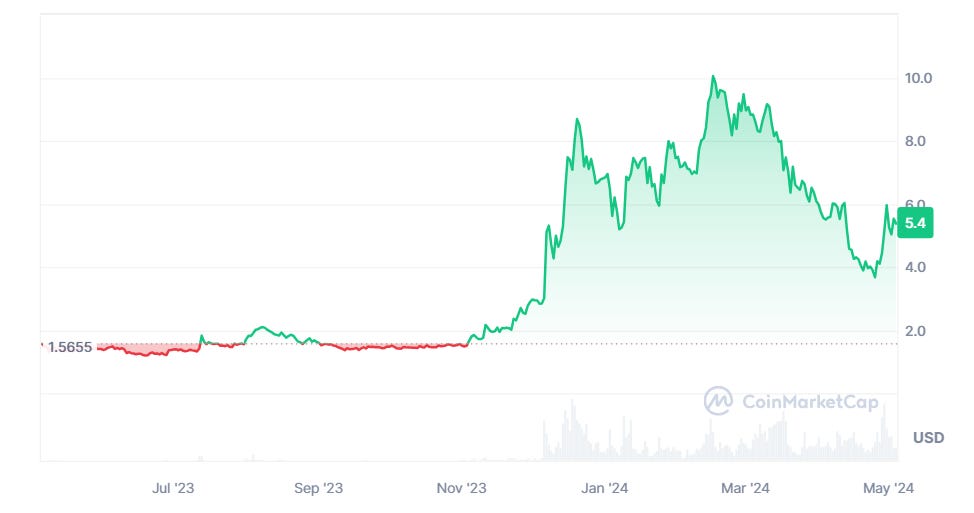
Here are some additional statistics:
Market Cap: $856,082,446 USD
Trading Volume in the last 24 hours: $17,179,588 USD
CoinMarketCap ranking: #94
Circulating Supply: 160,875,442 HNT
Total Supply: 160,875,442 HNT
Max Supply: 223,000,000 HNT
Fully Diluted Market Cap: $1,186,657,327
The Highest Price: $54.88 - Nov 12, 2021 (over 2 years)
The Lowest Price: $0.1132 - Apr 18, 2020 (about 4 years)



Network Usage
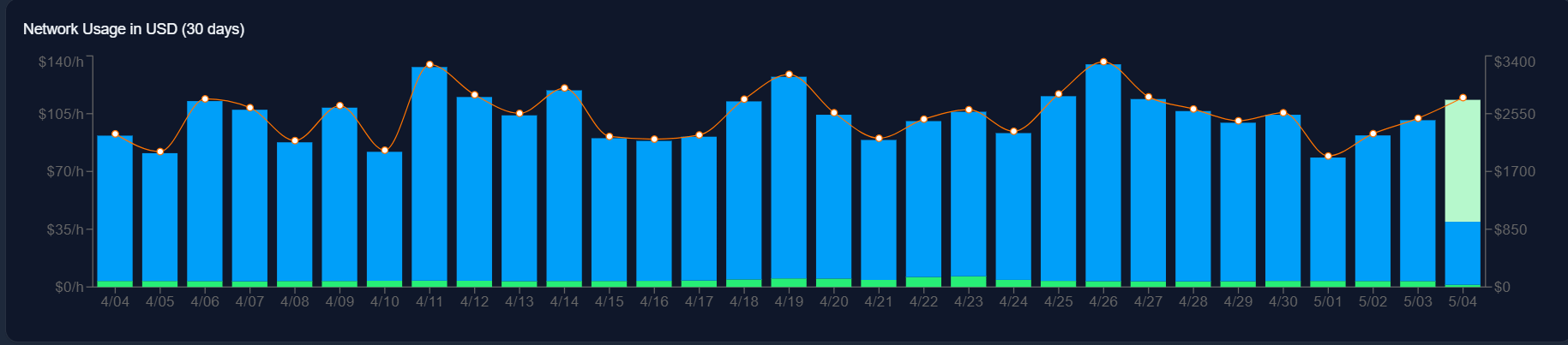

Predicting the price of Helium (HNT) crypto from 2025 to 2030 involves considering various factors, including market trends, technological advancements, regulatory environments, and broader economic conditions. Here's a summary of the predictions across different sources:
2025 Predictions: Coincodex predicts HNT could trade between $5.36 and $25.32, with a potential increase of 371.09% to reach $25.32 if it hits the higher value target.
According to Coinedition Price
2026 Predictions: Coinedition expects a notable decline in HNT's price to $10.50 due to potential market liquidity issues.
2027 Predictions: Coinedition projects a bearish scenario for HNT in 2027, with a predicted price of $8.95, influenced by potential regulatory issues.
2030 Predictions: Coinedition sees a bullish price prediction for HNT, with a value trade at $35, despite potential declines in 2026 and 2027.
These are just predictions and should never be considered financial advice. Always do your due diligence before investing in cryptocurrencies. Various factors, including market trends, technological advancements, and the regulatory environment, can influence the future value of HNT.
Separating Fact From Fiction in Helium's Controversial Path to Mainstream Acceptance
Helium (HNT) offers several unique advantages and features that make it stand out in the realm of decentralized networks and the Internet of Things (IoT):
Helium aims to improve the communication capabilities of wireless Internet of Things (IoT) devices. In 2013, infrastructure around IoT was still in its infancy, but developers wanted to add decentralization to their offering, hence referring to it as “The People’s Network” in official literature.
Its core appeal will be to device owners and those interested in the IoT space, with financial incentives providing further outreach possibilities.
Network participants purchase Hotspots — a combination of a wireless gateway and a miner — or build their own. Each hotspot provides network coverage over a certain radius, and also mines Helium’s native token, HNT.
The network runs on proof-of-coverage, a new consensus algorithm based on the HoneyBadger BFT protocol which allows nodes in a network to reach consensus when connection quality is highly variable.
Passive Income Generation: Individuals can earn passive income by setting up and maintaining a Helium miner. This involves validating and transmitting data, which is compensated with HNT tokens. These tokens can be exchanged for other cryptocurrencies or traditional currency.
Decentralization and Enhanced Security: The decentralized nature of Helium mining distributes control over the network, enhancing network security and reducing vulnerability to cyber threats.
Community Involvement: Participating in Helium mining offers a chance to join a dynamic community of miners and IoT enthusiasts, fostering a platform for sharing experiences and staying updated on the latest trends in the Helium ecosystem.
Eco-Friendly Approach: Helium mining is more energy-efficient compared to traditional mining processes, making it a sustainable choice for those interested in cryptocurrencies.
Integration of Blockchain Technology, Wireless Infrastructure, and IoT: Helium uniquely combines these elements, transforming how we use cellular data and wireless internet and offering crypto investors the opportunity for passive income through Helium mining.
Low Cost and Scalability: Helium uses a proof-of-coverage consensus mechanism, allowing network participants to earn cryptocurrency for providing coverage to specific geographic areas. This makes it more cost-effective to operate an IoT network on Helium than traditional networks. Additionally, the Helium network is designed to scale efficiently as the number of connected devices increases.
Energy Efficiency and Flexibility: Helium employs a low-power, long-range wireless protocol called LoRaWAN, enabling extended battery life for connected devices and supporting various applications and use cases, including asset tracking, environmental monitoring, and smart cities.
Helium, marketed as the "People's Network," has faced several criticisms and challenges that highlight its drawbacks:
Misleading Promises and Financial Incentives: Helium has been accused of creating a "fear of missing out" by promising significant earnings and passive income to early adopters. However, these promises have not materialized for many participants, leading to disappointment and financial loss. The company's financial incentives, which disproportionately benefit executives and investors, contrast sharply with the minimal rewards for hotspot owners, leading to frustration among the community.
Switch to Vendor-Specific Hardware: Initially, Helium supported a wide range of hotspot devices, including affordable DIY options. However, the company shifted towards a walled garden approach, limiting hotspot devices to specific vendors. This change has led to higher costs for hotspot owners and has not effectively addressed concerns about fraud or spoofing.
Efficiency and Profitability Issues: The Helium network has experienced saturation in certain markets due to an oversupply of hotspots. This saturation reduces the profitability of individual hotspots as they compete for limited data traffic. Despite claims of significant network usage and partnerships, actual data usage remains low, indicating a disconnect between the network's expansion and its adoption by end-users.
Operational Changes and Community Backlash: Helium's decision to limit the types of hardware that can be used for hotspots has been criticized as anti-consumer. The introduction of HIP-19, which restricts the availability of crypto rewards to approved manufacturers, has been seen as undermining the decentralized ethos of the network. This move has alienated some community members and raised questions about the network's commitment to inclusivity and decentralization.
Financial Performance and Market Perception: Helium's cryptocurrency, HNT, has seen its value plummet, reflecting broader market trends and concerns about the network's ability to generate revenue. The financial performance of hotspot owners has been particularly disappointing, with some reporting earnings that fall far short of expectations. This has led to skepticism about the viability of Helium as a profitable investment or a successful implementation of Web3 technology.
Customer Engagement and Network Usage: Despite the network's rapid expansion, actual customer engagement and data usage remain low. This discrepancy between the network's growth and its utilization suggests ongoing challenges in attracting and retaining users, which are critical for the network's sustainability and profitability.
In the early days, Helium allocated a higher proportion of HNT to hotspot owners for building and securing coverage. But as more people join the network and services start using it, Helium is burned (destroyed) to generate Data Credits (DC), which is the “currency” Helium users can pay for data on the network.
Hotspot owners are already complaining about their decrease in earnings on forums, with many saying they’re earning much less per day than they did when they started. Many sought to recuperate their costs within the first few months, but are now looking at years. That means people who buy a hotspot to start earning HNT at a later time will never be able to catch up to the hotspot owners who opted in at the start.
An additional obstacle is the complexity involved in earning HNT. Hotspot owners earn tokens based on the quality of the coverage they provide and the amount of LongFi sensor data they transport for devices on the network. Earnings are subject to complex variables like device’s location, hardware, position of their device and antennas, size of the antennas, distance of other hotspots, and more. Because of this, many people are gaming the system via spoofing and other methods to try and earn more HNT even if they’re not providing actual quality coverage.
While many people undoubtedly have earned HNT, all or most of it was due to hotspot activity and not user activity. On top of that, none of that is actual profit until you cash out your HNT, and with the current bear markets, most people are hanging onto their tokens in the hopes that the coin’s value rebounds. Yet the coin’s value at this time is purely speculative and is heavily based on how well the network can attract actual paying customers.
Conclusion
In conclusion, Helium presents a groundbreaking approach to building a decentralized wireless infrastructure for the burgeoning Internet of Things (IoT) sector. Its unique blend of blockchain technology, wireless networking, and IoT integration sets it apart from existing centralized solutions. Helium creates opportunities for passive income generation, enhanced security, and eco-friendly mining practices by empowering individuals to host Hotspots and contribute to the network's functionality.
However, critics argue that Helium's ambitious goals face numerous challenges, such as misleading financial promises, vendor lockdown, efficiency concerns, operational changes, and fluctuating market perception. While the network boasts impressive growth metrics, the disparity between expansion and customer engagement doubts its long-term viability and profitability. Moreover, the decreased earnings for hotspot owners and the complexity surrounding HNT acquisition may discourage newcomers.
In the competitive landscape, Helium faces rivals such as Tonomy, Deepventure.io, Nova Labs, IoTeX, Moeco, etc. Each project has unique strengths and focuses, making the storage industry dynamic and highly competitive.
Ultimately, whether to invest in Helium depends on each individual's risk tolerance, understanding of the underlying technology, and appreciation for the project's objectives. Investors must weigh the potential benefits and pitfalls carefully and consider conducting thorough research before committing funds to Helium or any other cryptocurrency venture.

📌Must Read
Google Cloud’s Web3 portal launch sparks debate in crypto industry
Summarized: Google Cloud recently launched a Web3 portal with testnet tools, blockchain data sets, and learning resources for developers, and it has received mixed reactions from the crypto industry.
Google Cloud has introduced a new Web3 portal with resources for blockchain developers, including data sets and tutorials on creating nonfungible tokens (NFT). However, the reception within the cryptocurrency industry has been mixed.

“No native Bitcoin and lightning support? Seems like an oversight to ignore the most important cryptocurrency,” vice president of product marketing at Unchained Phil Geiger stated in an X post on April 25.

“Not impressed Google is way behind,” pseudonymous crypto trader MartyParty told his 80,700 X followers on April 26.
It also has a learning program with tutorials on developing an NFT, implementing Web3 loyalty programs, and securing digital assets with multi-party computation.
This comes after several recent developments by Google in the Web3 industry.
Most recently, Google expanded its features to allow users to search wallet balances across multiple blockchains, such as Bitcoin, Arbitrum, Avalanche, Optimism, Polygon, and Fantom. At the beginning of 2024, Google updated its policies to allow certain crypto products, including Bitcoin exchange-traded funds, to be advertised on major search engines.
In 2023, Google appeared to focus on establishing partnerships for this year's portal launch. In October 2023, Google Cloud’s BigQuery data warehouse was integrated with MultiversX, which will help Web3 projects and users derive valuable insights from powerful data analytics and artificial intelligence tools within the Google Cloud ecosystem.
A month before this, in September 2023, Google’s BigQuery added 11 blockchain networks to its data warehouse.

The Shredderz: Web3 Rock and Heavy Metal Band Launches NFTs
Summarized: Web3 rock and heavy metal band The Shredderz launched an NFT collection on OpenSea, which reshapes fan interaction.
The Shredderz, a web3 rock and heavy metal band,, continues to make waves in industry spaces with a new non-fungible token (NFT) collection. The platform recently rolled out an NFT collection dubbed Shredz, which includes 6,666 hand-drawn characters, each linked to a Shredderz song.

The Web3 band seeks to scale up music collectible interaction by offering a gamified listening experience to metal fans. This move will help foster a Web3 listening culture and build innovations in values around blockchain technology.
Shredz will grant holders access to a gamified listening experience on Audius, a decentralized streaming platform. Shredderz's NFT collection will be exclusively on OpenSea and will include a partnership with Lifescore’s Artificial Intelligence technology. This will breathe new life into their debut album, creating thousands of new songs across multiple genres and adding value to the wider industry.
What’s In For The Shredderz Fans?
Used Shredderz NFTs will have access to the listening platform and other benefits. The holder of the token can cover song selections, influence artwork choices and merchandise designs
Audius offers a gamified listening experience, offering users the opportunity to earn rewards such as new music, merchandise, and festival tickets. Furthermore, Shredderz offers a guitar game in which users aim to win a Brandon Ellis signature guitar, thereby increasing community participation.
The democratization of the offerings and ecosystem increases fan experience within the community.
Team Sets Sights on Fan Culture
Martin Geramita, a team member, explained that Shredderz saw a void within the crypto community and sought to create a fan-controlled band.
“We saw a void in the crypto community and decided to fill it. With the support of our friends, we brought The Shredderz to life. Our vision was to create the first predominantly fan-controlled band, where everyone feels like they’re not just spectators, but integral members of the band itself.”
Also, Chris Walsh, the CEO of LifeScore, noted that the band would release extended versions and allow fans to create remixes in real time.

Your Weekly Dose of Web 3
Paragraph raises $5 million from USV and Coinbase Ventures, takes over web3 blogging platform Mirror
Web3 Projects Have Lost More Than $401M to Hackers in 2024: Immunefi
Google Cloud Teams with Sui Blockchain to Improve Web3, AI in Advanced Tech Initiatives
NFTBank Unveils V2 Upgrade to Boost NFT & Web3 Game Treasury