
🚨Spheron's💰$50,000 Bounty Program for Developers, Tether Nets $5B Profits This Year,📘Deep Dive Neura Protocol
Unleashing Web 3 Awesomeness Powered By Spheron Network

In today’s edition:
Innovate and Earn: Boundless Opportunities with spheron's $50,000 Bounty Program
Tether Nets $5B Profits This Year, Says Its U.S. Debt Holdings Surpassed Germany's
Deep Dive into Neura
Your Weekly dose of Web3
Total Read Time: 10 Min 23 Seconds
📌Must Read
Innovate and Earn: Boundless Opportunities with Spheron's $50,000 Bounty Program
Summarized: Join the Spheron Bounty Program to innovate with decentralized GPU access, compete for a share of the $50,000 bounty pool, and receive 72 hours of unrestricted GPU access to create groundbreaking applications.
Spheron is committed to revolutionizing decentralized GPU accessibility, and they want YOU to be a part of this exciting journey. They aim to inspire developers to create groundbreaking applications using Spheron's Decentralized GPU Network and partner layers. The possibilities are endless, from AI Bots to Models, Agent Stores, and beyond!
By participating in the bounty program, you'll be at the forefront of shaping the future of DePIN Compute. Your contributions will help refine our developer tools and enhance the user experience. Ready to make your mark? Let's dive in!
Bounty Allocation
Spheron has allocated a generous bounty pool of $50,000 to reward your innovative projects. But wait, there's more! As Spheron onboard more partners, the bounty prizes will increase, offering even greater incentives for your hard work.
All developers participating in the bounty program will receive 72 hours of unrestricted GPU access. How cool is that?
Available GPUs
Our program offers access to high-performance GPUs, including:
RTX3090
RTX4090
A6000
And that's not all! Stay tuned for even more high-end servers coming soon. 👀
Bounty List Overview
Spheron has a diverse range of bounty projects from which you can choose. Flex your coding muscles using open-source frameworks like Langchain, Huggingface, FastApi, vLLM, Ray, and more!
For general submission guidelines, please follow the GitHub repo
Ready to change the future of decentralized GPU accessibility? The Spheron Bounty Program is your chance to shine! Spheron encourages developers from all backgrounds to join them in this exciting venture. Let's make some magic happen! 🌟

Tether Nets $5B Profits This Year, Says Its U.S. Debt Holdings Surpassed Germany's
Summarized: Tether alone now owns more US government debt than major countries like Germany, the UAE, and Australia — and they’re not only profiting from it, but driving blockchain adoption in the process.
You know those boring businesses you hear about every now and then that absolutely print money?
Yeah, well — stablecoins are kinda like that.
The leading stablecoin, Tether, just reported its earnings. So far this year, it has earned $5.2 billion. (How? By taking a small percentage of the money invested into their coin, and re-investing it to eek out a profit — big bank energy).
Here’s why this is important and likely to grow:
The US government generates cash by selling IOUs (typically to other countries) with set interest rates — and to these other countries, it’s a solid deal cause the US is seen in the same light as the Lannisters (from Game of Thrones):
Problem is…
There is only so much US debt that other nation-states can/are willing to buy, and the US is forever hungry for fresh cash.
Stablecoins are the perfect instrument for extending demand for US debt. They increase the reach of the US dollar by allowing users anywhere to buy US dollars instead of their (often less reliable) local currencies.
And this ain’t some hair-brained theory!
It’s already happening in real time. Tether owns more US government debt than major countries like Germany, the United Arab Emirates, and Australia.
(Quickly driving blockchain adoption in the process).
We love to see it.
🔎 Deep Dive
Neura: A Fair Model or a Recipe for Disputes?
Welcome to our Deep Dive section, where we examine the cutting-edge technology behind Web3 infrastructure, DePIN, and blockchain. Today, we will cover Neura Protocol, a revolutionary blockchain platform designed for Artificial Intelligence (AI).
We will also discuss the challenges Neura may face in achieving its objectives and analyze its position within the competitive landscape. Stay tuned as we embark on this exciting journey to discover the true potential of Neura Protocol and its role in shaping the future of AI and blockchain technologies.
Here is How Everything Started. (History & Founders)
Chandler Song founded the Neura Protocol. The idea behind Neura is to create a blockchain platform specifically designed for AI, enabling advanced AI creation, training, and deployment. It leverages decentralized GPU resources, secure data storage, and innovative economic models to power AI operations. The platform integrates AI, cloud, Web3, and cryptography technologies to offer scalable, affordable, and secure AI solutions.
Here's how Neura works🤔
Neura Protocol combines decentralized GPU resources, secure data storage, and innovative economic models to facilitate AI development and deployment. Here’s a breakdown of its working mechanism based on the whitepaper:
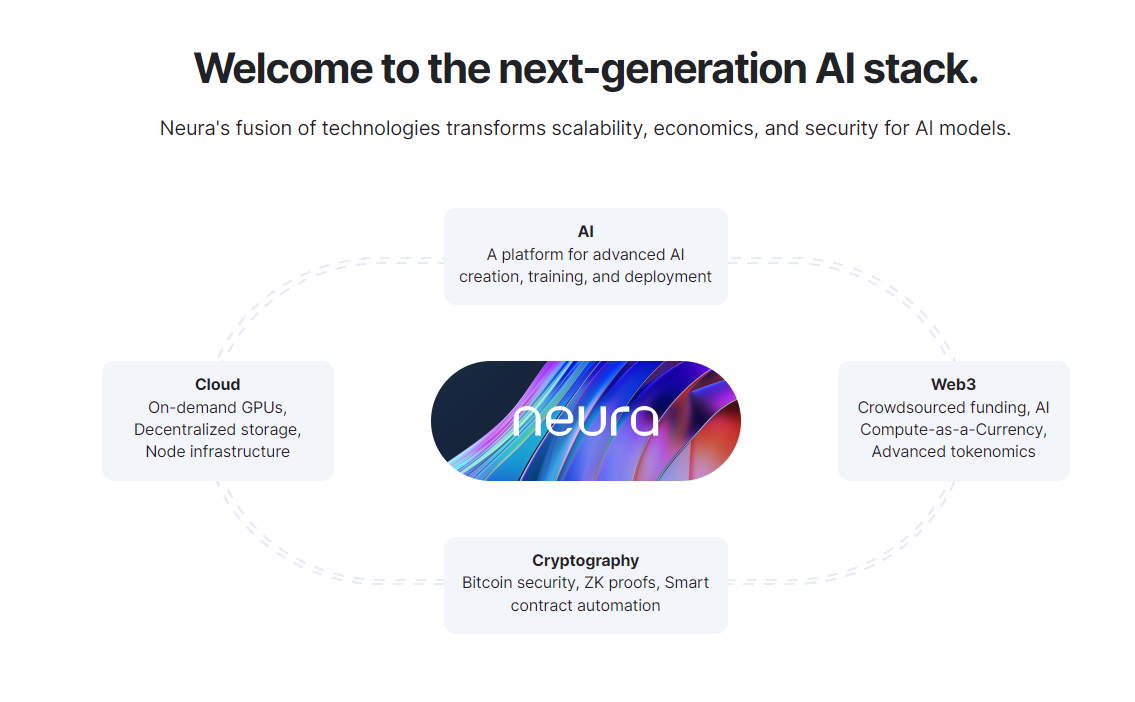
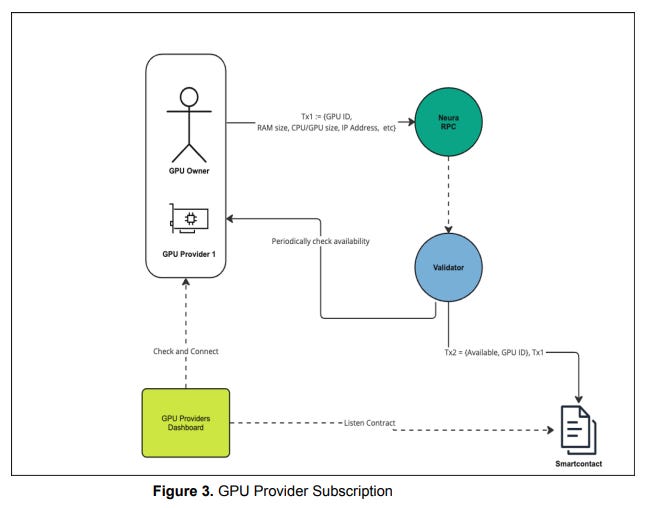
Decentralized Computing: Neura uses a network of distributed GPUs for AI training and inference. GPU providers register and make their resources available, which are then verified by validators to ensure reliability.
Task Submission: AI model owners encrypt their tasks and submit them to off-chain storage like Arweave or IPFS. These tasks are then processed by selected GPU providers who decrypt, execute, and return the results.
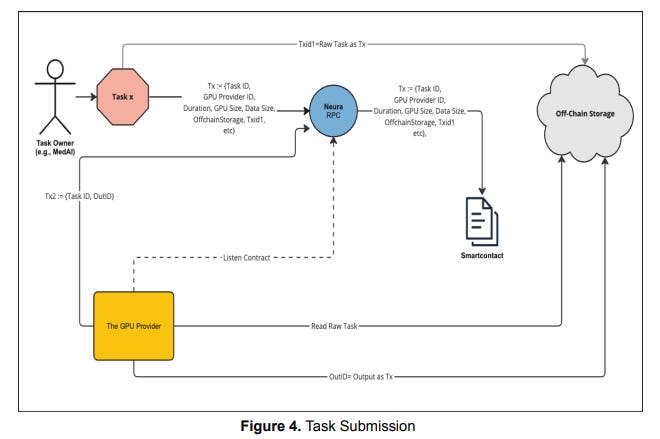
Smart Contracts: Smart contracts on Neura manage task submission, resource allocation, and payment, ensuring transparent and automated interactions between AI model owners and GPU providers.
Economic Model: The platform uses ANKR tokens for transactions, staking, and rewards. It also supports ERC-404 and ERC-7641 token standards for tokenizing AI models and sharing revenue among contributors.
Data Storage: Neura employs a hybrid storage model, storing large AI models off-chain while keeping references and metadata on-chain to ensure integrity and accessibility.
Interoperability: Built on the Cosmos SDK, Neura ensures seamless interoperability with other blockchain networks, enhancing the integration of AI and blockchain technologies.
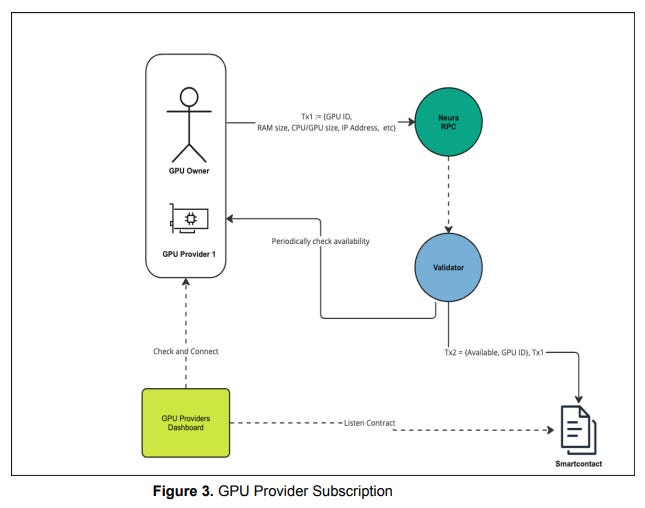
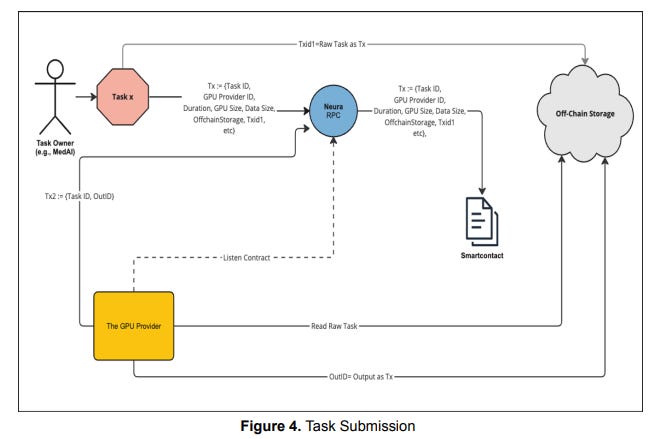
This comprehensive approach addresses scalability, financial barriers, and interoperability, facilitating a robust ecosystem for AI innovation on the blockchain.
For more details, you can refer to the Neura White Paper.
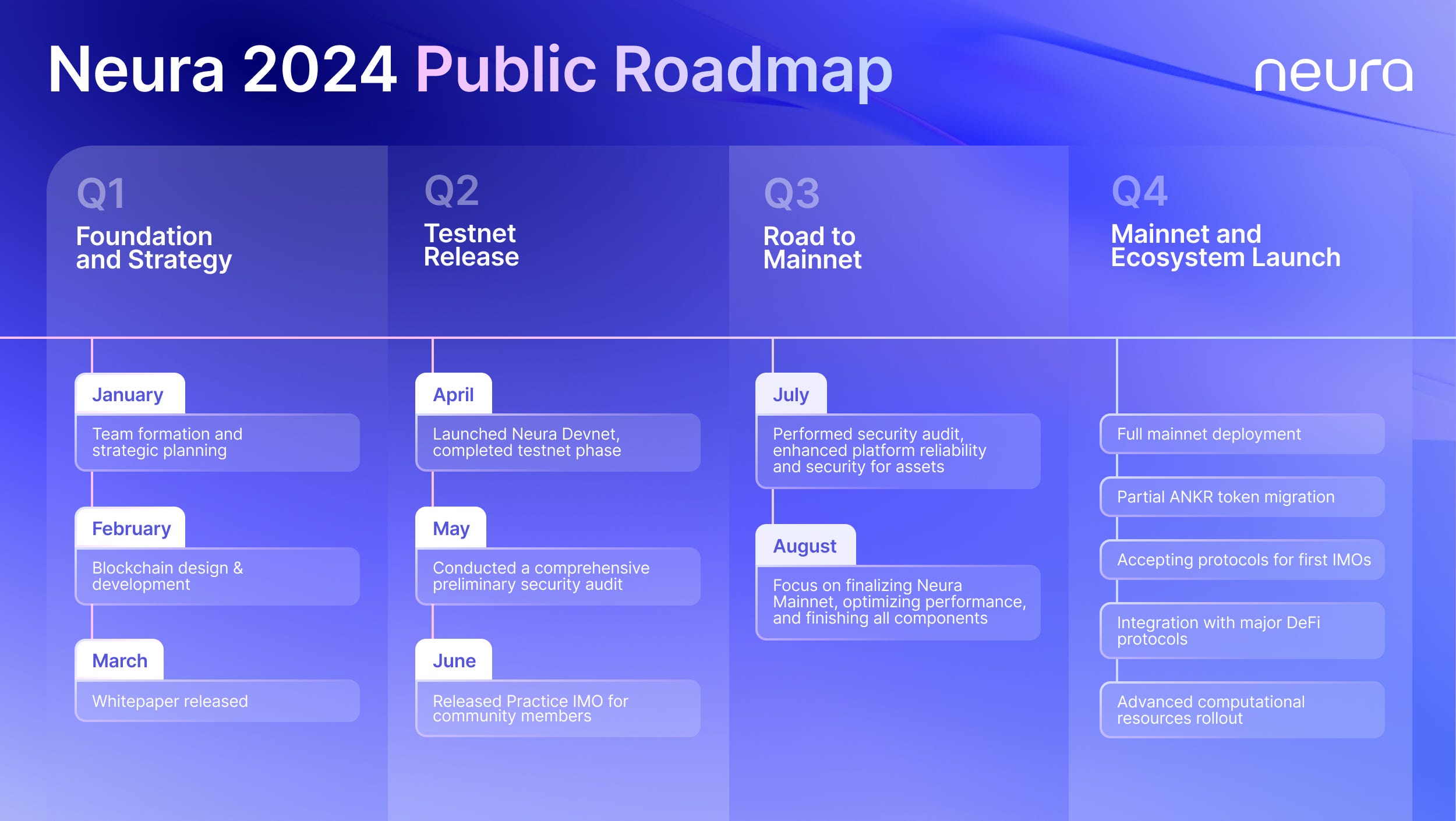
Project Roadmap of Neura
The current market of Ankr (HNT)
The ANKR token is essential to Neura's operations. It serves as the universal currency for accessing GPU resources, participating in IMOs, and acquiring AI services. It rewards GPU providers and compensates AI developers, fostering an ecosystem of innovation and growth.
The launch of Neura highlights the indispensable role of the ANKR token within its ecosystem, demonstrating its clear utility, demand, and broader strategy for growth and innovation it supports. By emphasizing ANKR's integral role and the innovative economic models Neura introduces, Ankr aims to showcase the token's significant value proposition to holders and ecosystem participants.
As of August 4th, 2024, the live ANKR price is $0.02548, with a 24-hour trading volume of $8,835,171 USD. Ankr is down 4.28% in the last 24 hours.
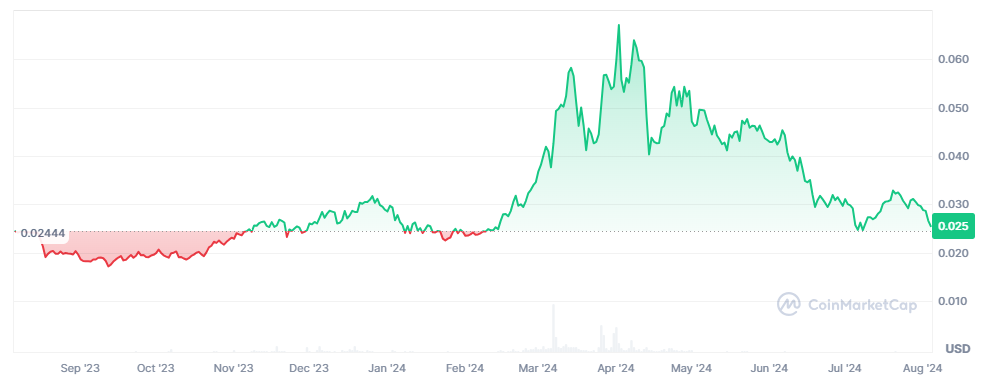
Here are some additional statistics:
Market Cap: $254,907,894 USD
Trading Volume in the last 24 hours: $8,823,394 USD
CoinMarketCap ranking: #170
Circulating Supply: 10,000,000,000 ANKR
Total Supply: 10,000,000,000 ANKR
Fully Diluted Market Cap: $254,920,337
The Highest Price: $0.2135 - Apr 16, 2021 (over 3 years)
The Lowest Price: $0.0007073 - Mar 13, 2020 (over 4 years)
Predicting the exact price of cryptocurrencies like Ankr (ANKR) is inherently challenging due to the highly volatile nature of the crypto market. However, based on the information gathered from various sources, we can provide a general overview of ANKR's price predictions for the coming years.
Price Predictions for 2025
CCN predicts ANKR's price in 2025 could range from $0.08 to $0.33, depending on whether the market enters a correction phase or reaches a new all-time high.
Ambcrypto forecasts ANKR's price in 2025 to be around $0.046, ranging from $0.037 to $0.055.
Long-Term Price Predictions (2026-2035)
Ambcrypto provides a long-term outlook for ANKR, predicting prices to increase gradually, reaching $0.075 in 2027, $0.095 in 2028, and potentially hitting $0.61 by 2035.
These are just predictions and should never be considered financial advice. Always do your due diligence before investing in cryptocurrencies. Various factors, including market trends, technological advancements, and the regulatory environment, can influence the future value of ANKR.
Neura: A Fair Model or a Recipe for Disputes?
Ankr has officially launched the public testnet for Layer 1 blockchain, Neura, specifically designed for AI. The Neura blockchain offers an enhanced foundation for AI projects with a fusion of tech to transform scalability, economics, security, and interoperability.
Decentralized GPU Marketplace: At the heart of Neura lies a dynamic marketplace that empowers developers with scalable access to GPU resources, crucial for AI and blockchain computations. This ecosystem democratizes access to computational power, bridging the gap between GPU providers and developers.
Initial Model Offerings (IMOs): Neura's groundbreaking funding mechanism, the IMO, enables AI projects to secure investment and computational resources via the blockchain. This innovation represents a significant leap forward in blockchain-based AI development, offering a sustainable growth pathway for emerging technologies.
AI Token Sales: Although ANKR is Neura's universal gas token, AI projects can launch their own cryptocurrencies on the network to enable collective project ownership, AI model usage payments, and other functionality.
Fractionalized Ownership: Utilizing ERC-404 tokens, Neura enables fractional ownership of projects, facilitating powerful new business models for AI.
Revenue Sharing: Share profits from AI usage automatically using ERC-7641 tokens and spread rewards to contributors and investors.
Decentralized Storage Solutions: By employing cutting-edge off-chain storage solutions like EigenLayer, Celestia, Arweave, and IPFS, Neura ensures efficient and secure data storage. However, the Neura blockchain is critical for ensuring The blockchain's role is crucial in maintaining data integrity and establishing Neura as a robust platform for data-intensive AI and blockchain applications.
21M BTC Marketcap Security: Neura harnesses the unparalleled security of staked Bitcoin, courtesy of the Babylon protocol, creating the safest environment for on-chain data. Due to Neura’s integration with Babylon, its PoS system will be able to utilize Babylon’s trustless scalable staking features to unlock value from the idle, unencumbered $1 trillion Bitcoin ecosystem.
While comprehensive details about Neura are still emerging beyond its documentation and whitepaper, it's confirmed that the Ankr token (ANKR) will be integral to all operations on Neura. Examining the existing Ankr platform can help you better understand what to expect from Neura, as these insights can provide valuable indicators of Neura's potential technical features and performance.
Complexity for Beginners: Despite efforts to simplify the staking process, newcomers to cryptocurrency might find the concepts of staking, liquid staking, and interacting with DeFi protocols challenging. The learning curve could be steep for those not familiar with blockchain technology.
Hardware Dependence: Ankr relies on Intel SGX technology, which, while enhancing security, limits the number of users who can support Verification Nodes due to the cost and complexity of the required hardware. This dependency can restrict scalability and accessibility for a broader user base.
Fees Impacting Returns: Ankr charges a technical service fee for staking services, which is deducted from the staking rewards. While competitive, these fees can impact overall returns, especially for smaller investors or those engaging in liquid staking. It's crucial for users to factor in these costs when calculating potential earnings.
Risk of Slashing: Although Ankr takes measures to mitigate slashing risks by selecting reliable validators, the risk of slashing (penalties for validator misconduct) remains inherent in the staking process. Users need to be aware that their staked assets could be at risk if the selected validators act maliciously or incompetently.
Community and Adoption: Despite its technological advancements, Ankr struggles with community engagement and widespread adoption. The Ankr subreddit, for instance, has a very small user base and limited activity, indicating a lack of strong community support.
Documentation and Transparency: Users have reported issues with the availability and clarity of Ankr's documentation. There have been complaints about the lack of accessible white papers and comprehensive guides, which can hinder new users' understanding and engagement with the platform.
Complexity of Staking Mechanisms: Although Ankr offers liquid staking, which is more flexible, the process can still be complex for those unfamiliar with staking and blockchain technology. This complexity might deter potential users who seek simpler, more straightforward investment opportunities.
Conclusion
By leveraging decentralized GPU resources, secure data storage, and innovative economic models, Neura aims to revolutionize AI development and deployment. Its integration of AI, cloud, Web3, and cryptography technologies addresses scalability, affordability, and security challenges, creating a robust ecosystem for AI innovation. Neura's functionality includes a decentralized computing network, task submission through off-chain storage, smart contracts for automated interactions, and a unique economic model powered by ANKR tokens. This token facilitates transactions and incentivizes GPU providers and AI developers, underpinning the platform's economic ecosystem.
However, Neura also faces challenges. The complexity of staking mechanisms, hardware dependencies, and the need for clear documentation can pose hurdles for beginners. The reliance on technologies like Intel SGX and the potential risk of slashing further complicate the landscape. Additionally, community engagement and adoption remain areas for improvement, as a robust and active user base is crucial for long-term success.
In the competitive landscape, Neura faces rivals such as Filecoin, ICP, Akash Network, Golem, Storj, Spheron Network, etc. Each project has unique strengths and focuses, making the storage industry dynamic and highly competitive.
In conclusion, Neura Protocol's ambitious vision for integrating AI and blockchain holds promise but also entails risks and challenges. Its success will depend on how effectively it simplifies complex processes, enhances community engagement, and maintains robust security measures. As the project evolves, potential users and investors must conduct thorough research and consider their own risk tolerance and technical expertise before engaging with Neura and the ANKR token.

Your Weekly Dose of Web 3
Web3 Community Celebrates The Olympics In The Metaverse and Beyond
Telegram Launches in-app Browser and Mini App Store Making Web3 Available to Almost a Billion Users
Web3 to become Saudi Arabia’s new oil as it dominates the industry
Brands that don’t succeed in Web3 didn’t ‘jump into the water’
Binance Labs Invests in Particle Network to Enhance Web3 Experience