
This Week's Web3 Breakthroughs:📱Telegram reponds on founder Pavel Durov Detained,💰Trump's NFT Collection Hits $2 Million,🚀Bitcoin Bulls Ready? Fed’s Rate Cuts Could Spark a Crypto Market Resurg
Unleashing Web 3 Awesomeness Powered By Spheron Network

In today’s edition:
Market Matrics
Must Read News Before Weekend
This Friday for the Spheron Podcast! (13:00 UTC)
Spheron Weekly Update: Fizz Node, Migration to Spheron Testnet Chain, CLI & Provider Updates
ELI5 For Spheron Fizz Node
Project Spotlight: Kaisar Network
Total Read Time: 7 Min 50 Seconds
We've revamped the Web3Infra newsletter to offer deeper insights and knowledge into the latest Web3 news and infrastructure developments. Here’s what’s new:
Market Metrics
A weekly roundup of key market metrics to keep you informed on the latest trends and movements.
Total Crypto Market Cap: up 1.12% to $2.1T
Total AI Sector Market Cap: down 0.09% to $23.8B
Total Computing Tokens Market Cap: down 5.53% to $18.6B
Total Decentralized Exchange (DEX) Market Cap: up 1.5% to $13.7B
Trending (24hrs)
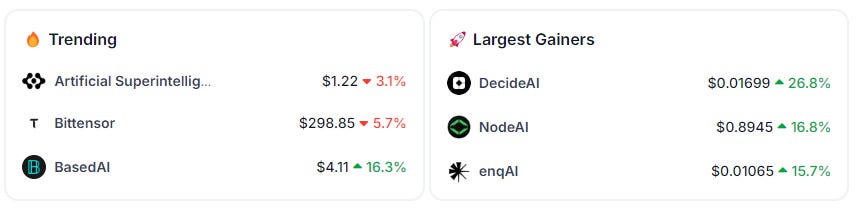

📌Must Reed News Before Weekend
A curated selection of the past week's most interesting and impactful Web3 news.
1. Telegram Responds to Founder and CEO Pavel Durov's Arrest in France
Telegram's founder and CEO, Pavel Durov, was arrested in France on Saturday, reportedly by the National Anti-Fraud Office, over alleged illegal activities by Telegram users that the platform allegedly failed to moderate. Telegram asserted that Durov has "nothing to hide" and emphasized the company's compliance with EU laws. The arrest has led to a significant drop in the price of Toncoin (TON), the token of Telegram-affiliated The Open Network, which fell by 17% before partially recovering. Durov's detention could extend up to 96 hours, after which legal actions may follow.
2. McDonald’s Gets Rugged, Bitcoin Fan RFK Backs Trump
McDonald’s Instagram account was hacked, leading to the promotion and subsequent rug pull of a Grimace-themed meme coin, resulting in a $700,000 scam. Meanwhile, in U.S. politics, pro-crypto candidate Robert F. Kennedy Jr. dropped out of the presidential race and endorsed Donald Trump, sparking excitement among crypto enthusiasts who view Trump as supportive of the industry. The Democratic National Convention, however, did not mention crypto policy, causing concern among crypto advocates, though a senior advisor to Kamala Harris later emphasized her support for the industry.
3. Crypto Markets Poised for Resurgence as Fed Signals Looming Rate Cuts: Analysts
Crypto market resurgence, led by Bitcoin, as central banks, especially the U.S. Federal Reserve, is expected to cut interest rates, injecting fresh liquidity into financial markets. Analysts believe this monetary easing could boost risk assets like cryptocurrencies despite current uncertainties such as the U.S. presidential election and elevated equity valuations. QCP Capital and Nansen highlight the "Fed put," where the Fed may support markets as inflation cools, as a key bullish driver for crypto. However, analysts advise caution, suggesting investors reduce crypto exposure during rallies and focus on major assets like Bitcoin and Ethereum.
4. Google's Gemini AI Gets ‘Gems’ and Built-In Image Maker
Google has launched a significant update to its AI model, Gemini, introducing customizable "Gems" and integrating its AI image generator, Imagen 3. Gems allow users to create modular AI assistants for various tasks, such as project brainstorming or social media content creation and are available to Gemini Advanced, Business, and Enterprise users. Unlike OpenAI’s GPT, shared chats with Gems cannot be continued by others. Imagen 3 enhances Gemini’s capabilities by generating high-quality images from text prompts, though it currently excludes human images due to prior issues. Google emphasizes its cautious approach, including extensive testing and policy adherence, as it rolls out these new features to compete with AI tools from OpenAI and others.
5. Trump's Latest NFTs Top $2 Million in Sales—With Only 5% Sold So Far
Donald Trump's fourth NFT collection, the "America First Edition," has generated over $2 million in sales since its debut despite selling only 5.7% of the 360,000 NFTs. This new collection, featuring Trump in various imaginative poses and minted on the Polygon network, is priced at $99 per card and includes potential perks like attending a gala with Trump or receiving Trump-branded items. While initial sales are slower than his earlier, smaller collections, the project could earn up to $35.6 million if fully sold. The NFTs cannot be resold until 2025, and the collection is listed on OpenSea, which recently received a Wells Notice from the SEC indicating potential legal action over NFTs being considered securities.
Bonus News
A Fake Spy, Russian Oil and $1 Million Funneled to Democrats (WSJ)
PayPal’s PYUSD stablecoin hits $1B market cap (CoinTelegraph)
Half of TikTok users under 30 say they use it to keep up with politics, news (Pew Research)
Metaplanet Adds ¥500 Million Worth of Bitcoin to Its Treasury (TFTC)
Spot bitcoin ETFs see eighth day of inflows (TheBlock)
Chinese government hackers penetrate U.S. internet providers to spy (WaPo)
🎙️ Join This Thursday the Spheron Podcast! (13:00 UTC)
Catch the latest episode of the Spheron Podcast, which has quickly gained popularity for featuring groundbreaking projects in the Web3 space.
Every week, spheron hosts a podcast that features some of the favorite personalities and projects in the Web3 space. Here is what we’ve got for this Friday.
Prakarsh, from Spheron's Founder's Office and Head of BD SwanChain, Jean-Luc Pellerin to discuss a crucial topic: "The Future of AI - How SwanChain is Revolutionizing Decentralized AI Infrastructure"
📅 Date: Thursday, August 29, 2024
⏰ Time: 13:00 UTC
📺 Watch LIVE on Spheron X, YouTube, Linkedin Socials
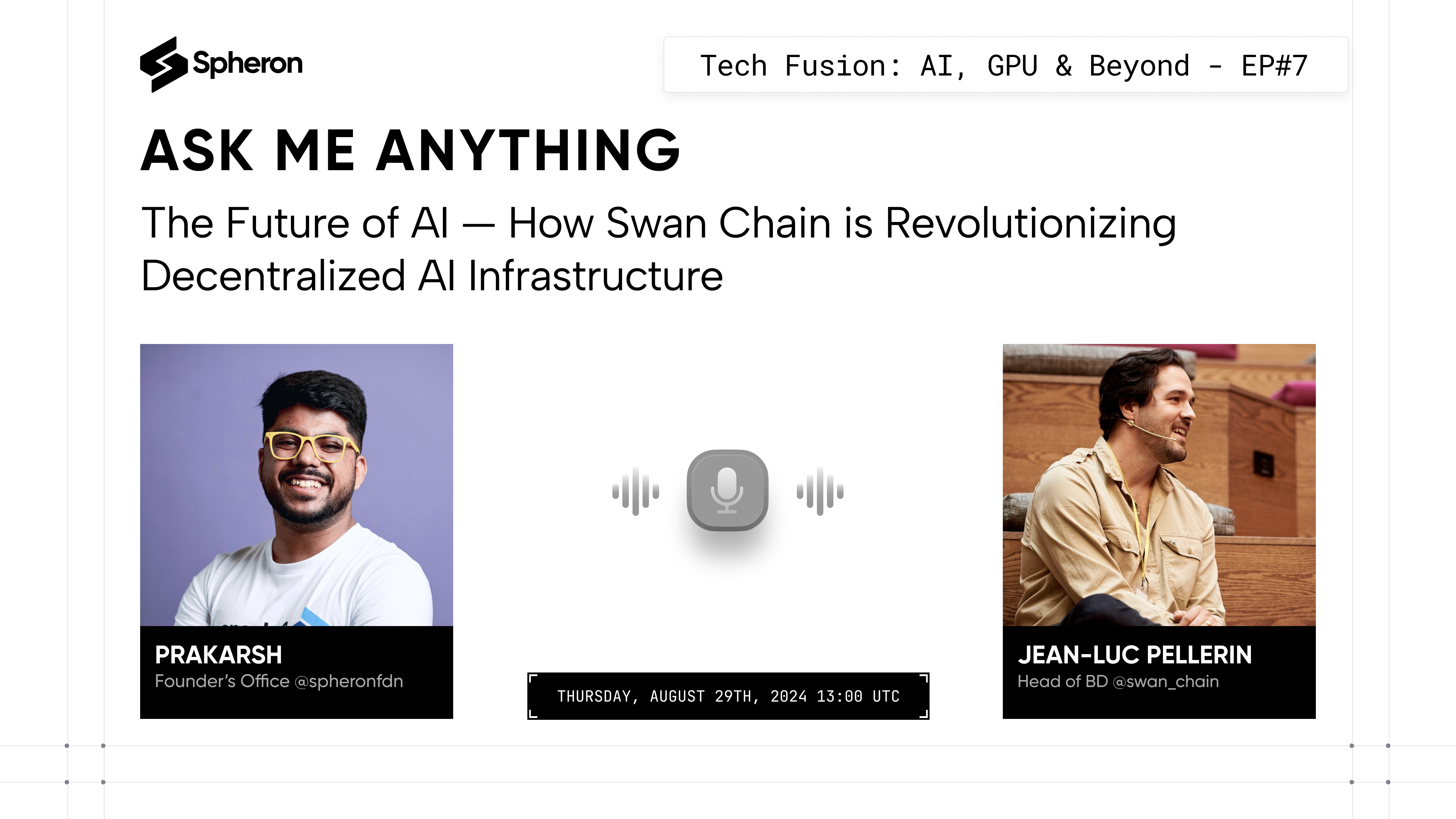
Don't miss this insightful discussion as we explore the future of decentralized technology. Set your reminders!
🚀 Spheron Weekly Update: Fizz Node, Migration to Spheron Testnet Chain, CLI & Provider Updates
Stay updated with the latest developments in the Spheron Network. We’ve added this section to highlight Spheron’s efforts in building a decentralized GPU platform, which can potentially become the next big thing in Web3. Keep an eye out for their upcoming $SPHN token launch.
Spheron has announced several key updates to enhance your deployment experience:
1. Fizz Node (Spheron Light Node)
Introduction of Fizz Nodes: Lightweight nodes that enable participation in Spheron’s decentralized compute network using smaller devices like laptops or small servers.
Key Features:
Lightweight Participation: Ideal for those with underutilized compute resources.
Subnet Formation: Fizz Nodes can connect to Provider Nodes to form subnets, which have their own economy, governance, and rewards.
Decentralized Economy: Subnets enhance the scalability and dynamism of the Spheron Protocol.
Components:
Fizz Client: Software for offering compute resources on small devices for rewards.
Gateway Service: Managed by providers to facilitate communication between users and Fizz Nodes.
Setup Instructions:
Visit fizz.spheron.network and click on "Register New Fizz Node."
Register your node by entering details such as node name, OS, resources, and provider.
Download and run the installation script (
fizzup.sh) and verify the setup.Access the dashboard to monitor node details and rewards.
2. Migration to Spheron Testnet Chain
Successful migration of the Spheron platform from Arbitrum Sepolia to Spheron's own Spheron Testnet (L3) Chain. This transition includes the movement of all chain operations from Arbitrum Sepolia to the new Testnet (L3) chain.
Key Updates:
Enhanced Performance: Migration improves the network's scalability, performance, and security.
Token Bridge: A bridge is available for transferring Sepolia test tokens to the Spheron Testnet.
How to Transfer Tokens:
Use the Spheron Testnet Bridge to transfer tokens.
Acquire test tokens from the Spheron Faucet.
3. Provider & CLI Updates
The new CLI update supports selecting the Deployment Mode (Provider Mode or Fizz Mode) within the ICL YAML file.
Key Features:
Mode Selection: Choose the mode based on resources, stability, and cost.
Flexibility: Allows optimized deployments tailored to specific project needs.
For more information, visit the Spheron documentation.
Check out all the details at Spheron’s Changelog.🎉
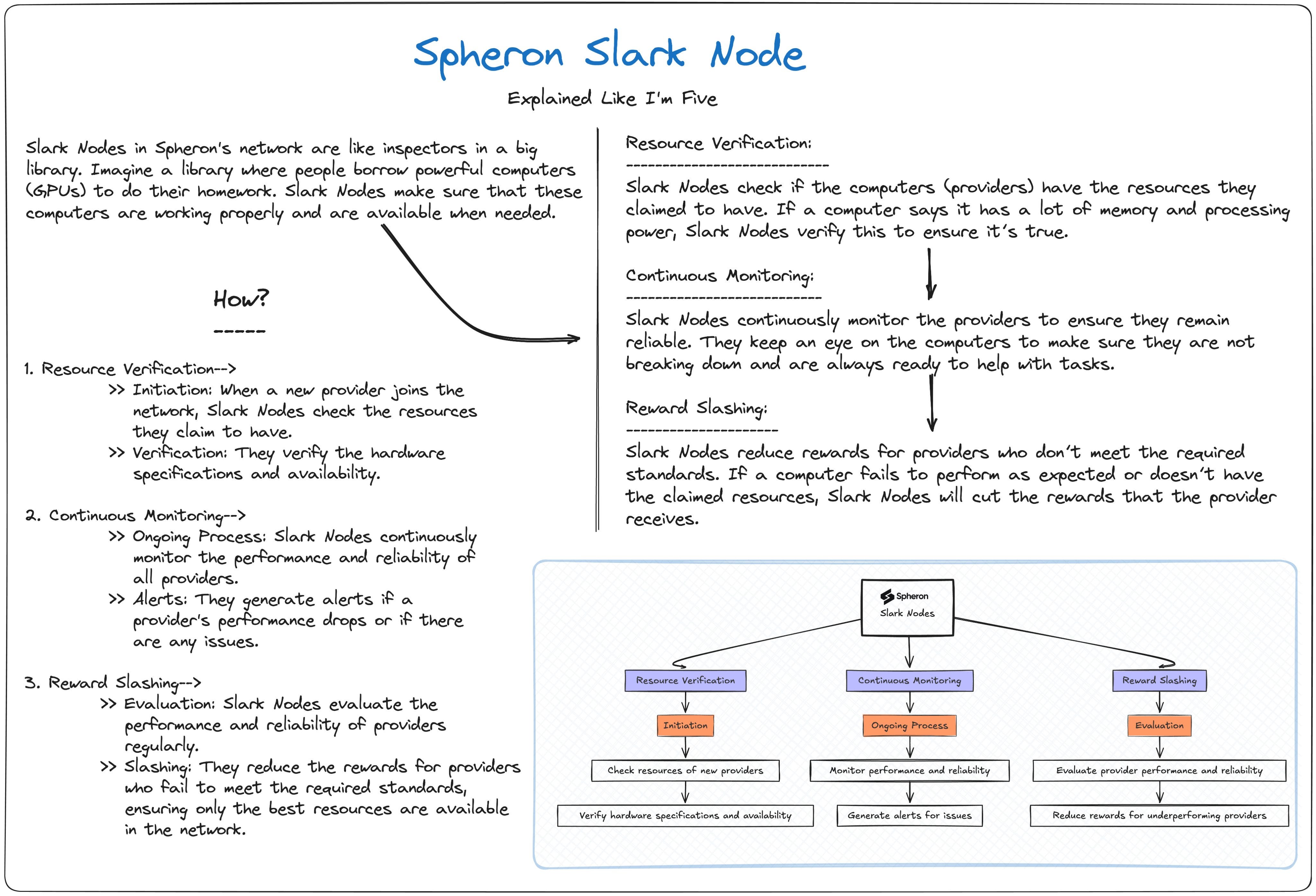
ELI5 For Spheron Fizz Node
This "Explain Like I’m Five" section breaks down complex mechanisms from various ecosystems into easy-to-understand explanations, complete with diagrams.
Spheron Decentralized GPU Network is made possible by community-run Slark Nodes! These nodes help to uphold network performance and integrity by auditing GPU providers and their compute power. Spheron's latest ELI5 focuses solely on Slark Nodes and their function. Head over to learn more at: https://docs.spheron.network/
🔦Project Spotlight: Kaisar Network
Each week, we spotlight a project significantly contributing to the Web3 ecosystem, helping it grow and thrive.
The introduction of Large Language Models (LLMs) and AI chatbot technologies in 2023 has significantly heightened the demand for high-performance computing. A detailed analysis of the training compute requirements (measured in FLOPs) of major machine learning systems reveals a dramatic increase in computational needs. Between 1952 and 2010, compute requirements doubled every 18 months, but from 2010 to 2022, this doubling time accelerated to just six months. The rise of large-scale models since late 2015 further exacerbated this trend, with compute needs starting two to three orders of magnitude higher than before, doubling every ten months.
As competition for processing power escalates among companies and nations, the potential of underutilized processors connected to the Internet worldwide remains largely untapped.
Kaisar's Role in DePIN Innovation
Kaisar is a pioneering force in the Decentralized Physical Infrastructure Network (DePIN) movement, offering a Layer 1 (L1) interoperable blockchain tailored for DePIN projects. Kaisar provides a DePIN platform with pre-built container templates that simplify the training and scaling of custom AIs, making use of some of the most advanced models available today.
Leading the DePIN Market
Kaisar employs Proof of Physical Work (PoPW) technology, with governance facilitated by its native KAI token. This system rewards machines that contribute processing power and DePIN builders who generate transactions on the network, creating a decentralized, positive-sum economy. Kaisar’s blockchain is fully decentralized and supports micropayments for transaction fees and provider rewards, allowing anyone to join the network by simply downloading the Kaisar app.
What sets Kaisar apart from its competitors is its L1 network's seamless compatibility with the Ethereum Virtual Machine (EVM). While many competitors operate on Layer 2 (L2) solutions, Kaisar’s network is Polkadot-enabled and supports cross-chain machine IDs with Cosmos, Solana, Binance, and bridges to Ethereum. Additionally, Kaisar connects to over 30 blockchains via Wormhole, offering unmatched interoperability.
Scalability and Modularity
Kaisar’s network can handle over 100,000 transactions per second (TPS) with transaction costs as low as $0.00025. The network also provides a suite of modular DePIN functions, including self-sovereign machine IDs, seamless payment processing for machines, data storage and verification, data indexing, and autonomous AI agents, ensuring DePIN projects and dApps have all the tools necessary for success.
Behind the Technology
Kaisar’s network, powered by its blockchain, offers an efficient platform for customers seeking affordable computational power. Customers can access processing power from providers who earn rewards for sharing the unused cycles of their processors. The network facilitates direct, secure connections between customers and providers, eliminating the need for a centralized cloud service mediator.
The Kaisar architecture consists of several layers that work together to deliver a seamless, secure, and efficient user experience. The network employs advanced technologies to ensure scalability, reliability, and robustness, making it a leading choice for decentralized computing.
Key Roles in Kaisar Network
The Kaisar Network integrates three essential roles:
Container: Specialized computers that handle heavy computational tasks in real-time.
Manager: Facilitates the connection between users and Containers.
Checker: Monitors and evaluates the performance and service quality of Containers.
The KAI Token
KAI is the native utility token of the Kaisar ecosystem. It serves multiple functions, including transactions, incentives, governance, and staking. With a total supply of 1 billion tokens, KAI is central to the network's operations and growth.
Token Emission Plan
The network's token rewards are structured around a deflationary model and distributed to Providers, Validators, and Nominators over 12 years. This system ensures long-term sustainability and rewards active participation in the network.
Kaisar Network Roadmap and Team
Kaisar's core team comprises experienced professionals in blockchain, cloud computing, AI, and business development. The company plans to unveil more details about the project soon. Kaisar is preparing for its test net deployment, with a main net launch and KAI token generation event to follow.
Strategic Partnerships
Kaisar has secured strategic partnerships with industry leaders and has received significant support from incubators like the HashKey Group and WXblockchain’s Future3 Camp, positioning it for success in revolutionizing computing and AI.
Spheron X Kaisar Network: Partnership for a Global GPU Breakthrough
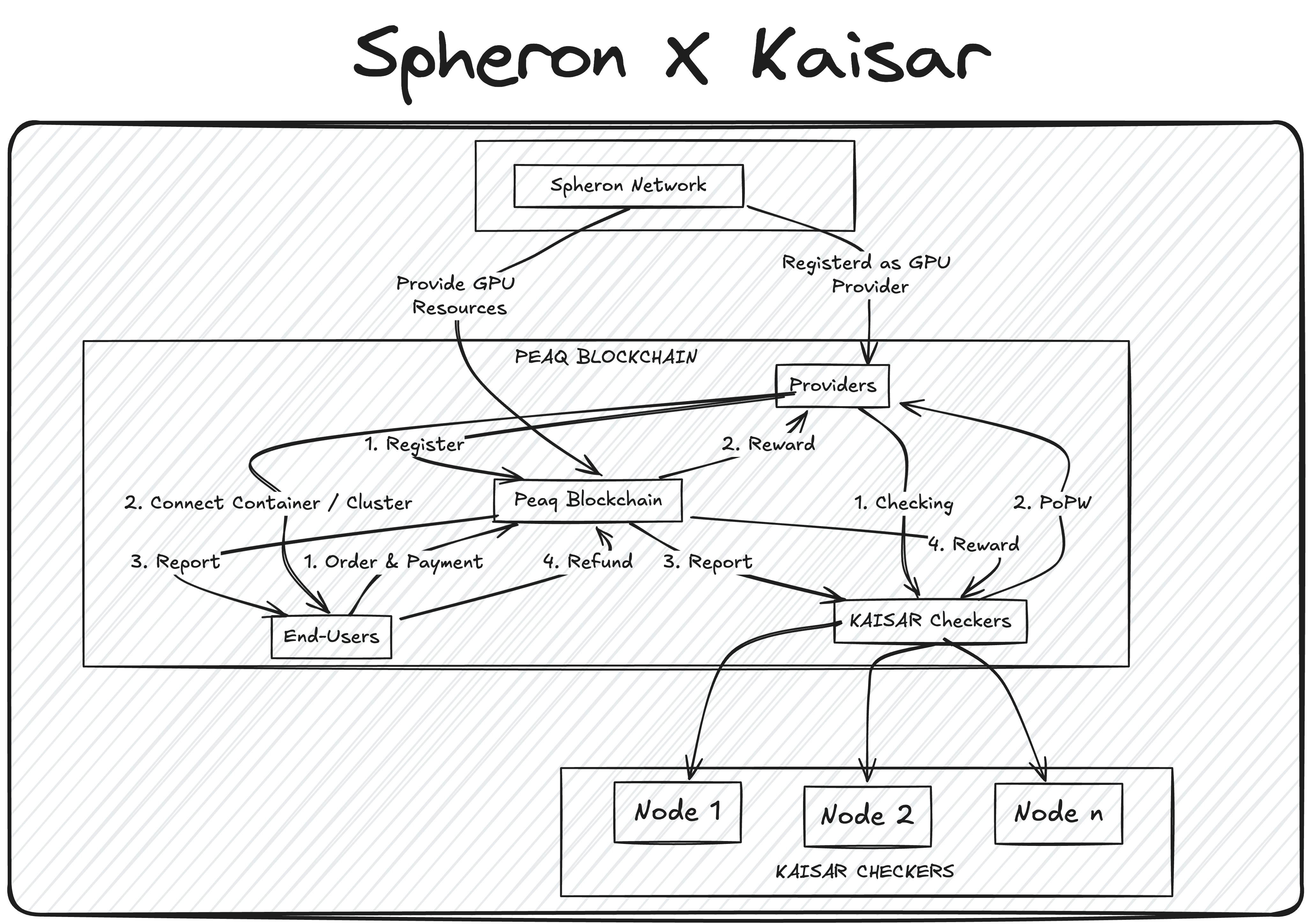
The partnership between Spheron Network and Kaisar is set to transform the decentralized physical infrastructure landscape by integrating Spheron’s decentralized compute platform with Kaisar’s DePIN, enhancing global GPU resource allocation.
Kaisar Network's Airdrop Campaign
Following the successful mint of its Genesis NFT, Kaisar launched an airdrop campaign to reward its community members, further engage users, and expand the reach of its network.
To begin this rewarding journey, users are encouraged to visit the Airdrop Portal at https://kaisar.io/airdrop/.